
DigitalOcean and Render both help developers deploy websites, apps, APIs, databases, and backend services. But they are not the same type of platform.
DigitalOcean is a cloud infrastructure provider. It gives you virtual servers, managed databases, object storage, Kubernetes, networking tools, firewalls, backups, and App Platform for managed app deployment.
Render is a modern platform as a service. It is built for developers who want to deploy directly from Git without managing servers. You connect your GitHub, GitLab, or Bitbucket repository, choose your service type, and Render handles deployment, TLS, builds, scaling, private networking, background workers, cron jobs, and databases.
The simple difference is this.
DigitalOcean gives you more infrastructure control.
Render gives you an easier deployment workflow.
If you want to manage servers, run WordPress, build custom infrastructure, use Kubernetes, or host many types of workloads, DigitalOcean is stronger.
If you want to deploy web apps, APIs, background workers, cron jobs, and PostgreSQL without touching server management, Render is easier.
Quick Comparison Table
| Category | DigitalOcean | Render |
|---|---|---|
| Platform Type | Cloud infrastructure plus managed app hosting | Platform as a service |
| Best For | Developers, startups, agencies, WordPress, SaaS apps, custom servers | Developers, SaaS apps, APIs, full stack apps, background workers |
| Starting Price | Droplets from $4/month | Hobby workspace $0/month plus compute |
| Web App Hosting | App Platform from $5/month | Web services from $0/month, paid from $7/month |
| Static Sites | Free tier on App Platform | Free static sites |
| Managed Databases | MySQL, PostgreSQL, MongoDB, Valkey, Kafka, OpenSearch | PostgreSQL and Key Value |
| Server Control | High | Low |
| Ease of Deployment | Good | Excellent |
| WordPress Hosting | Better | Not ideal |
| Background Workers | Available through App Platform | Strong |
| Cron Jobs | Possible, but not as simple | Built in cron jobs |
| Kubernetes | Yes | No traditional managed Kubernetes |
| Object Storage | Spaces available | Not a main storage product |
| Best For Beginners | Good for technical beginners | Easier for app developers |
| Best For Infrastructure Control | DigitalOcean | Not the focus |
| Best For Git Based Deployment | Good | Render |
DigitalOcean Overview
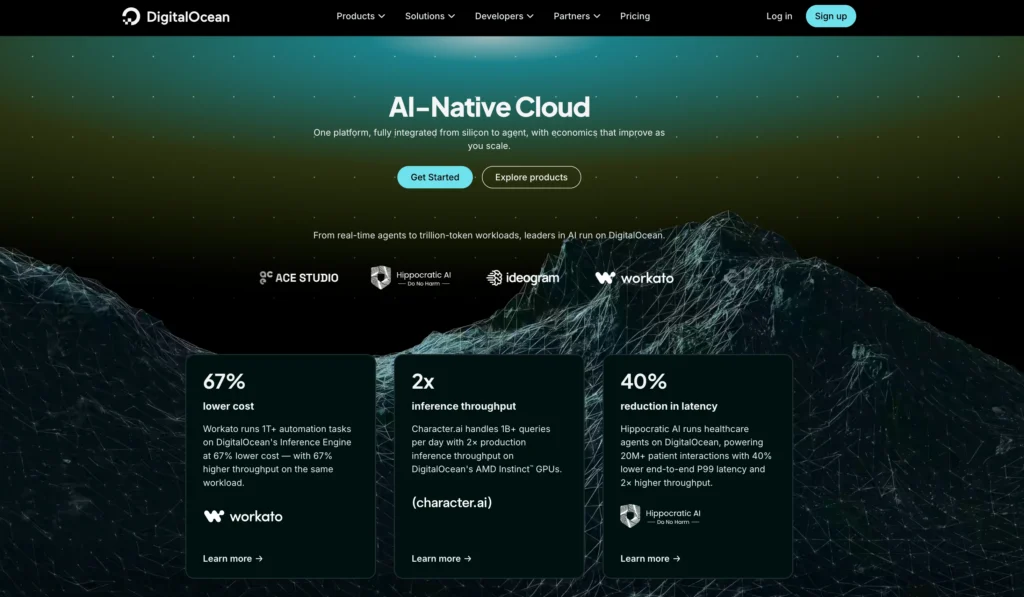
DigitalOcean is a cloud hosting provider built for developers, startups, agencies, SaaS companies, and technical website owners. Its main product is called a Droplet, which is a cloud virtual machine used to host websites, apps, APIs, databases, development servers, and production workloads.
DigitalOcean is popular because it makes cloud hosting easier than large enterprise providers like AWS, Google Cloud, and Azure. The dashboard is clean, pricing is easier to understand, and the documentation is strong.
DigitalOcean is not only a VPS provider anymore. It now offers Droplets, App Platform, Managed Databases, Kubernetes, Spaces Object Storage, Volumes Block Storage, Load Balancers, Functions, monitoring, firewalls, backups, snapshots, and developer tools.
This makes DigitalOcean a better choice when you want a complete cloud platform with more control over infrastructure.
DigitalOcean Features
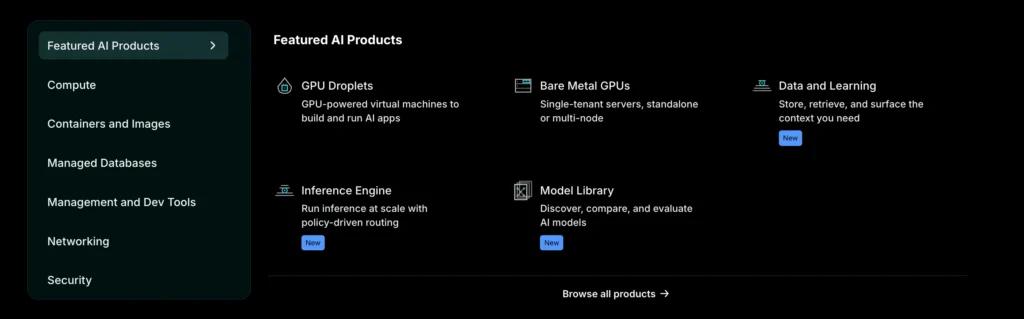
DigitalOcean gives users a full set of cloud tools. You can start with a small server and later add managed databases, object storage, load balancers, Kubernetes, and app deployment tools.
| DigitalOcean Feature | Details |
|---|---|
| Droplets | Cloud virtual machines for websites, apps, APIs, and custom workloads |
| App Platform | Managed app hosting for users who do not want to manage servers manually |
| Managed Databases | Supports PostgreSQL, MySQL, MongoDB, Valkey, Kafka, and OpenSearch |
| Kubernetes | Managed Kubernetes for container based applications |
| Spaces Object Storage | S3 compatible storage for images, backups, files, and static assets |
| Volumes Block Storage | Extra storage that can be attached to Droplets |
| Load Balancers | Distributes traffic across multiple servers |
| Cloud Firewalls | Helps control network traffic and protect servers |
| VPC Networking | Private networking between resources |
| Monitoring and Alerts | Tracks performance and server health |
| Backups and Snapshots | Helps protect data and restore servers |
| Marketplace Apps | One click apps such as WordPress, Docker, LAMP, Node.js, and more |
| API and CLI | Useful for automation and developer workflows |
| Functions | Serverless compute for event based workloads |
The biggest strength of DigitalOcean is flexibility. You can run a basic WordPress website, a Laravel app, a Node.js backend, a Docker based app, a database server, an API, or a Kubernetes cluster.
You can also use App Platform if you want a more managed deployment experience. This gives DigitalOcean some of the convenience of Render, while still keeping the wider cloud infrastructure ecosystem.
DigitalOcean Pricing
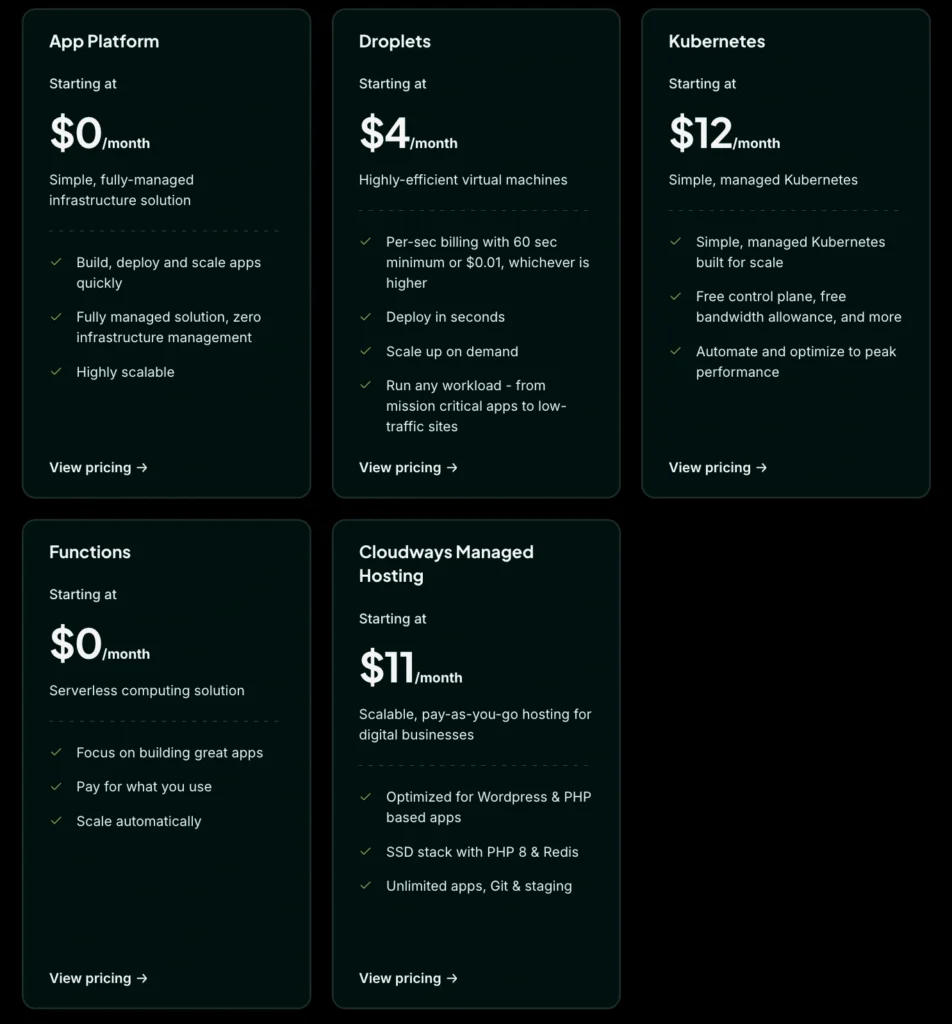
DigitalOcean has predictable pricing. Basic Droplets start at $4 per month. A more practical 1 GB RAM Droplet costs $6 per month, while the 2 GB plan costs $12 per month.
| DigitalOcean Product | Starting Price | Best For |
|---|---|---|
| Basic Droplets | From $4/month | Small websites, test apps, lightweight workloads |
| 1 GB Basic Droplet | $6/month | Small live websites and simple apps |
| 2 GB Basic Droplet | $12/month | Growing websites and apps |
| 4 GB Basic Droplet | $24/month | WordPress, APIs, ecommerce, SaaS projects |
| CPU Optimized Droplets | From $42/month | CPU heavy apps |
| General Purpose Droplets | From $63/month | Balanced production workloads |
| App Platform Static Tier | $0/month | Static websites and portfolios |
| App Platform Paid Containers | From $5/month | Managed app deployment |
| App Platform Development Database | $7/month | Lightweight PostgreSQL for development |
| Managed Databases | From around $15/month | PostgreSQL, MySQL, MongoDB, Valkey, and more |
| Spaces Object Storage | From $5/month | Media files, backups, app assets |
| Load Balancers | From $12/month | High availability and traffic distribution |
| Backups | 20% to 30% of Droplet cost | Automated backups |
| Kubernetes | Pay for worker nodes | Container based applications |
DigitalOcean can be cheaper than Render if you are comfortable managing your own server. For example, a $6 or $12 Droplet can host a small app or WordPress site if configured properly.
But the total cost changes when you add backups, databases, object storage, monitoring, load balancers, or paid support.
DigitalOcean is best when you want strong control over cost and infrastructure.
DigitalOcean Pros
| Pros | Why It Matters |
|---|---|
| More infrastructure control | You can configure servers, networking, databases, and storage your way |
| Low entry pricing | Droplets start from $4/month |
| Better for WordPress | One click apps and more server level control |
| Full cloud ecosystem | Compute, storage, databases, networking, Kubernetes, and backups |
| Strong documentation | Useful tutorials for developers and server admins |
| Managed databases | Supports more database engines than Render |
| Kubernetes available | Better for container focused teams |
| Object storage available | Spaces is useful for media, backups, and static files |
| App Platform available | Good for users who want managed app deployment |
| Better for agencies | Easier to host many types of client projects |
DigitalOcean Cons
| Cons | Why It Matters |
|---|---|
| More server responsibility | You may need to manage SSH, firewalls, updates, and security |
| Not as smooth as Render for Git deployment | Render is better for push to deploy workflows |
| App Platform can become costly | Managed app hosting costs more than running a basic Droplet |
| No traditional cPanel by default | Shared hosting users may find it unfamiliar |
| Free support is limited | Production users may need paid support |
| Setup takes more time | You need more configuration compared with Render |
| Scaling is more manual on Droplets | Render makes app scaling easier for many developers |
Render Overview
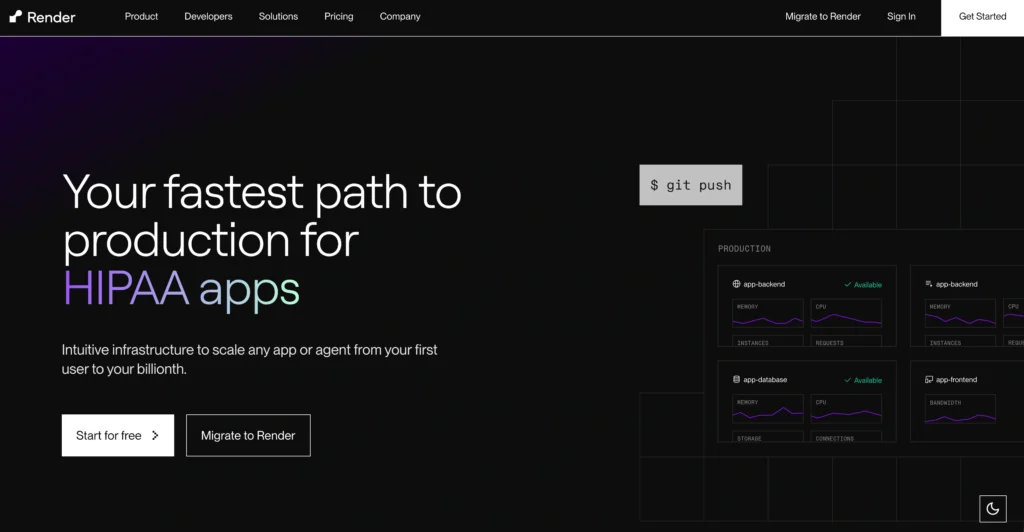
Render is a cloud application platform designed to make deployment simple. It is built for developers who want to ship web apps, APIs, static sites, background workers, private services, cron jobs, PostgreSQL databases, and key value stores without managing servers.
Render feels closer to Heroku than DigitalOcean. You connect your Git repository, choose your runtime or Docker setup, and deploy. Render handles builds, deploys, automatic TLS, service logs, private networking, scaling, previews, and managed databases.
This makes Render a strong choice for app developers who care more about speed than server control.
Render is not a traditional VPS provider. You do not rent a server and manage the operating system yourself. Instead, you deploy services on Render’s managed platform.
That is the biggest reason developers like it. It removes a lot of infrastructure work.
Render Features
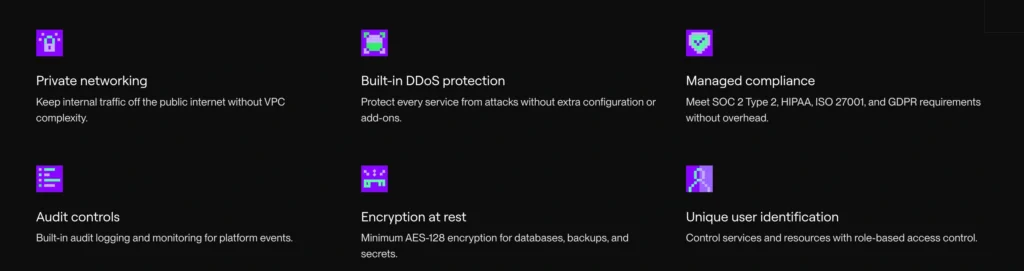
Render is focused on application deployment. Its features are built around modern full stack apps, backend services, managed databases, and team workflows.
| Render Feature | Details |
|---|---|
| Static Sites | Free static site hosting with CDN, Git deploys, and custom domains |
| Web Services | Hosts dynamic apps built with Node.js, Python, Go, Ruby, Rust, Elixir, Docker, and more |
| Private Services | Internal services that are not exposed publicly |
| Background Workers | Runs async jobs and background processing |
| Cron Jobs | Runs scheduled tasks using cron expressions |
| Render Postgres | Fully managed PostgreSQL databases |
| Render Key Value | Redis compatible key value store |
| Automatic TLS | HTTPS certificates handled automatically |
| Git Deployments | Deploy from GitHub, GitLab, or Bitbucket |
| Preview Environments | Preview changes before merging |
| Private Networking | Services can communicate privately |
| Persistent Disks | Attach SSD storage to services |
| Infrastructure as Code | Manage services through render.yaml |
| Logs and Metrics | Monitor app behavior from the dashboard |
| Autoscaling | Available on higher workspace plans |
| DDoS Mitigation and Firewall | Basic protection features included |
Render’s strongest feature is developer workflow. It is very easy to take an app from Git to production. You do not need to set up Nginx, configure system services, manage OS patches, or manually install TLS certificates.
This makes Render a great fit for SaaS MVPs, API backends, internal tools, dashboards, full stack apps, and products that need background workers and cron jobs.
Render Pricing
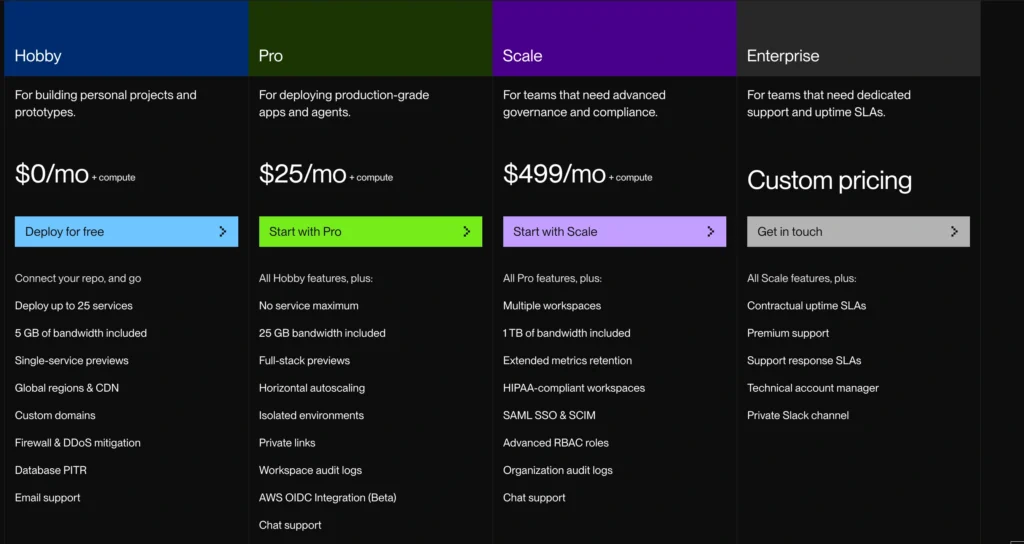
Render pricing is split into workspace plans and compute pricing.
The Hobby workspace is free and allows developers to build personal projects and prototypes. Paid workspace plans start at $25 per month plus compute for Pro, while Scale starts at $499 per month plus compute.
| Render Workspace Plan | Price | Best For |
|---|---|---|
| Hobby | $0/month plus compute | Personal projects, prototypes, small apps |
| Pro | $25/month plus compute | Production apps and teams |
| Scale | $499/month plus compute | Teams needing governance and compliance |
| Enterprise | Custom | Large teams needing premium support and SLAs |
Render compute pricing depends on service type and instance size.
| Render Product | Starting Price | Best For |
|---|---|---|
| Static Sites | $0/month | Static websites, portfolios, docs |
| Web Services Free | $0/month | Testing and small projects with usage limits |
| Web Services Starter | $7/month | Small production apps |
| Web Services Standard | $25/month | Apps needing 2 GB RAM and 1 CPU |
| Web Services Pro | $85/month | Larger apps |
| Render Postgres Free | $0 for limited free database | Testing and previews |
| Render Postgres Basic 256 MB | $6/month | Small development databases |
| Render Postgres Basic 1 GB | $19/month | Small app databases |
| Render Key Value Free | $0/month | Small cache and test use |
| Render Key Value Starter | $10/month | Small production cache |
| Cron Jobs | From around $1/month | Scheduled tasks |
| Persistent Disks | $0.25 per GB/month | Storage attached to services |
| Expandable Postgres Storage | $0.30 per GB | Database storage expansion |
Render can be very affordable for small apps because it has a free tier. But production apps can become more expensive than a simple VPS because you pay for each service.
For example, a real app may need a web service, PostgreSQL database, background worker, cron job, persistent disk, and paid workspace features. That can cost more than a DigitalOcean Droplet, but you save time because Render handles much of the deployment and infrastructure work.
Render Pros
| Pros | Why It Matters |
|---|---|
| Very easy deployment | Connect Git and deploy quickly |
| Great for web apps and APIs | Strong support for common languages and Docker |
| Free tier available | Useful for prototypes and personal projects |
| Managed PostgreSQL | Easier database setup |
| Built in cron jobs | Simple scheduled tasks |
| Background workers | Good for queues and async jobs |
| Automatic TLS | HTTPS is handled for you |
| Private networking | Services can communicate securely |
| Preview environments | Useful for teams and pull requests |
| Less server maintenance | No need to manage OS patches or server setup |
Render Cons
| Cons | Why It Matters |
|---|---|
| Less infrastructure control | You cannot manage servers like a VPS |
| Can get expensive with many services | Each app component may add cost |
| Not ideal for WordPress | DigitalOcean is better for WordPress hosting |
| Limited database variety | Mainly PostgreSQL and Key Value compared with DigitalOcean’s wider database lineup |
| No traditional VPS | Not suitable if you need full server access |
| Bandwidth overage can be costly | Render charges higher overage than many VPS providers |
| Advanced team features cost extra | Pro and Scale workspace plans add monthly fees |
| Not ideal for custom infrastructure | DigitalOcean is better for Kubernetes, object storage, and full cloud architecture |
DigitalOcean vs Render Feature Comparison
| Feature | DigitalOcean | Render | Winner |
|---|---|---|---|
| VPS hosting | Yes | No | DigitalOcean |
| Managed app hosting | Yes, App Platform | Yes, core product | Render |
| Static sites | Yes | Yes | Tie |
| Web services | Yes | Yes | Render |
| Background workers | Yes | Yes | Render |
| Cron jobs | Possible | Built in | Render |
| Managed PostgreSQL | Yes | Yes | Tie |
| Managed MySQL | Yes | No | DigitalOcean |
| Managed MongoDB | Yes | No | DigitalOcean |
| Managed Redis compatible service | Yes, Valkey | Yes, Key Value | Tie |
| Object storage | Yes, Spaces | Not a main product | DigitalOcean |
| Kubernetes | Yes | No | DigitalOcean |
| Server control | High | Low | DigitalOcean |
| Git based deploys | Good | Excellent | Render |
| WordPress hosting | Stronger | Not ideal | DigitalOcean |
| Free tier | Limited but useful | Stronger for app previews and small projects | Render |
| Best for agencies | DigitalOcean | Good for app agencies | Depends on use case |
DigitalOcean vs Render Pricing Comparison
| Product Type | DigitalOcean | Render |
|---|---|---|
| Lowest Entry | Droplet from $4/month | Hobby workspace $0/month plus compute |
| Static Site Hosting | App Platform free tier | $0/month |
| Small Web App | App Platform from $5/month | Web service Starter $7/month |
| VPS Hosting | From $4/month | Not available |
| 1 GB Cloud Server | $6/month | Not available as VPS |
| Managed PostgreSQL Entry | Around $15/month | Basic 256 MB from $6/month, Basic 1 GB from $19/month |
| Redis Compatible Cache | Valkey from $15/month | Key Value Starter from $10/month |
| Object Storage | Spaces from $5/month | Not a main storage product |
| Persistent Disk | Volumes from $10/month | $0.25 per GB/month |
| Load Balancer | From $12/month | Platform handles routing for services |
| Bandwidth Overage | Droplet overage around $0.01 per GiB | Workspace bandwidth overage around $0.15 per GB |
| Team Plan | Paid support optional | Pro workspace $25/month plus compute |
DigitalOcean usually wins on raw infrastructure cost.
Render usually wins on deployment speed.
If you only need a server, DigitalOcean is cheaper and more flexible.
If you want to deploy an app without managing servers, Render may be worth the higher monthly cost.
Which One Is Better for WordPress?
DigitalOcean is clearly better for WordPress.
You can launch WordPress on a Droplet, use one click marketplace apps, configure caching, add object storage, use Cloudflare, create backups, and scale resources as needed.
Render is not built for typical WordPress hosting. You could technically run many kinds of apps with Docker, but WordPress needs PHP, persistent files, database handling, media uploads, plugin updates, and server style management. DigitalOcean is a more natural fit.
If you are building a WordPress blog, WooCommerce store, affiliate site, or client website, choose DigitalOcean.
If you are building a custom web app, API, or SaaS dashboard, Render becomes more interesting.
Which One Is Better for Developers?
Render is better for developers who want the fastest path from code to production. It is especially useful for Node.js, Python, Django, FastAPI, Rails, Go, Rust, Elixir, and Docker based apps.
You connect your repo, push code, and Render handles the deployment pipeline.
DigitalOcean is better for developers who want more control over servers, databases, storage, Kubernetes, and networking. It gives you more freedom, but also more responsibility.
For app developers, Render is easier.
For infrastructure focused developers, DigitalOcean is stronger.
Which One Is Better for Startups?
Render is excellent for early stage startups that want to launch fast. If your team is building an MVP, SaaS product, internal tool, API, or dashboard, Render can save time because you do not need to manage servers.
DigitalOcean is better for startups that want cost control and infrastructure flexibility. If you have a technical team, you can run more workloads on lower cost Droplets and scale with managed databases, storage, load balancers, and Kubernetes.
For speed, choose Render.
For long term infrastructure control, choose DigitalOcean.
Which One Is Better for Agencies?
DigitalOcean is better for agencies that host WordPress sites, client websites, ecommerce stores, landing pages, and mixed hosting projects.
Render is better for agencies building custom apps, dashboards, SaaS products, APIs, and backend systems for clients.
If your agency mostly builds marketing websites, DigitalOcean makes more sense.
If your agency builds full stack applications, Render can be easier.
Which One Should You Choose?
Choose DigitalOcean if you want server control, lower infrastructure cost, VPS hosting, WordPress hosting, managed databases, Kubernetes, object storage, and a full cloud ecosystem.
Choose Render if you want easy app deployment, Git based workflows, automatic TLS, managed PostgreSQL, background workers, cron jobs, private services, and less DevOps work.
DigitalOcean is better when you want control.
Render is better when you want convenience.
Final Verdict: DigitalOcean vs Render
DigitalOcean and Render are both strong platforms, but they solve different problems.
DigitalOcean is better for users who want flexible cloud infrastructure. It is the stronger choice for VPS hosting, WordPress, Kubernetes, object storage, managed databases, agencies, and cost controlled hosting.
Render is better for developers who want to deploy apps quickly without managing servers. It is ideal for web apps, APIs, SaaS MVPs, background workers, cron jobs, and teams that prefer Git based deployment.
If you are building a website or need full server control, choose DigitalOcean.
If you are building a modern app and want a smoother deployment workflow, choose Render.
For most infrastructure needs, DigitalOcean is the better all around platform.
For fast app deployment, Render is easier and cleaner.